
 GEO
GEO  ENG
ENG  RUS
RUS 


Help other travelers use your experience.
Review this destination, share your thoughts, impressions, pros and cons.
Let's make traveling easier than ever.

დაამატეთ თქვენი რესტორანი Georgian Travel Guide-ზე — მიიღეთ ონლაინ ჯავშნები წინასწარი გადახდით და გახდით ხილული ყოველთვიურად 100 000-ზე მეტი მოგზაურისთვის.

განათავსეთ საკუთარი კოტეჯი / სასტუმრო ჩვენს პლატფორმაზე და გააცანით თქვენი მომსახურება 100 000-ზე მეტ მოგზაურს.

დაამატეთ თქვენი ავტომობილი Georgian Travel Guide-ზე და გახდით ხილული ყოველთვიურად 100 000-ზე მეტი მოგზაურისთვის.

ხარ გიდი? დაამატე შენი პროფილი Georgian Travel Guide-ზე და დაუკავშირდი მოგზაურებს პირდაპირ — შუამავალი კომპანიებისა და საკომისიოს გარეშე.

იცნობთ ადგილს, რომელიც რუკაზე ჯერ არავის დაუტანია? დაამატეთ ის Georgian Travel Guide-ზე უფასოდ და გააცანით ათასობით მოგზაურს. გაიცანი და გააცანი #უცნობისაქართველო

განათავსეთ თქვენი ტურები და აქტივობები Georgian Travel Guide-ზე და გააცანით ისინი ყოველთვიურად 100 000-ზე მეტ მოგზაურს, რომლებიც სწორედ ახლა გეგმავენ მოგზაურობას საქართველოში.
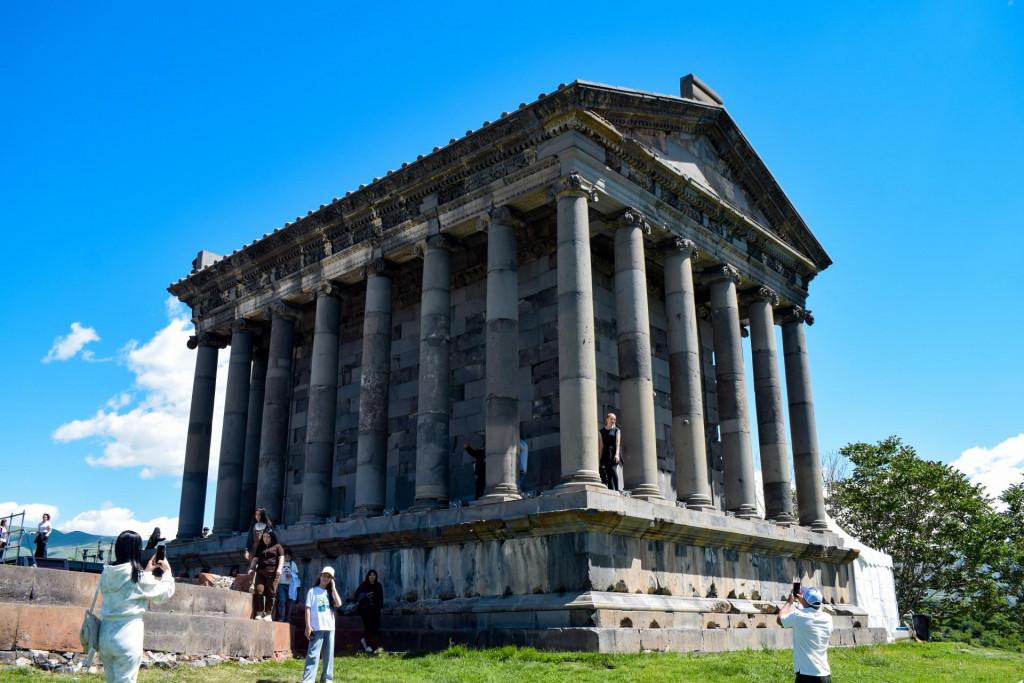
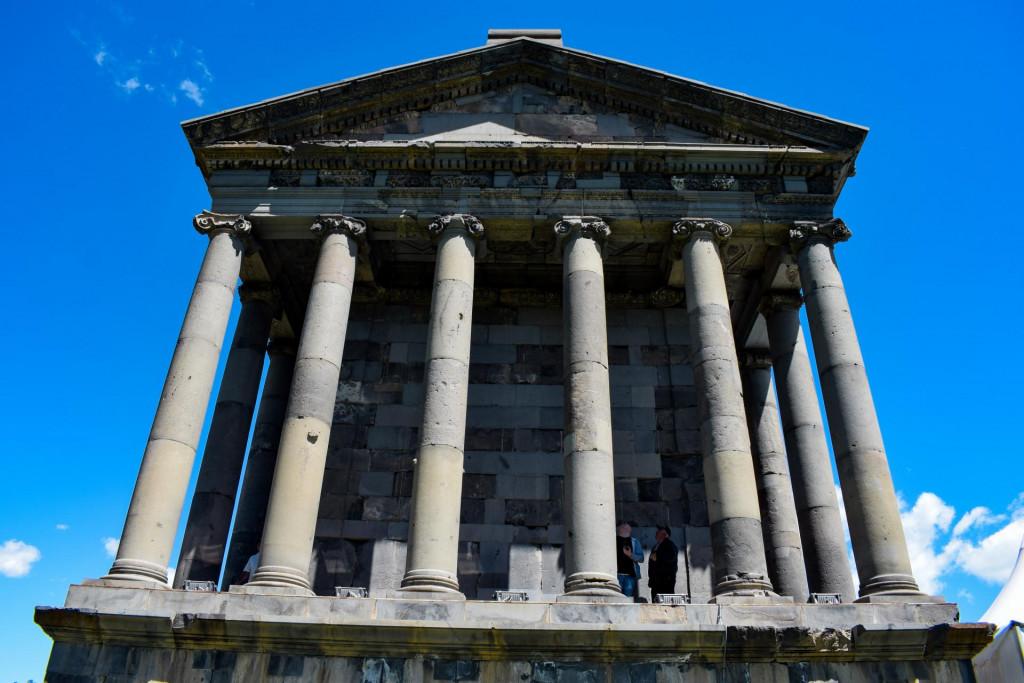
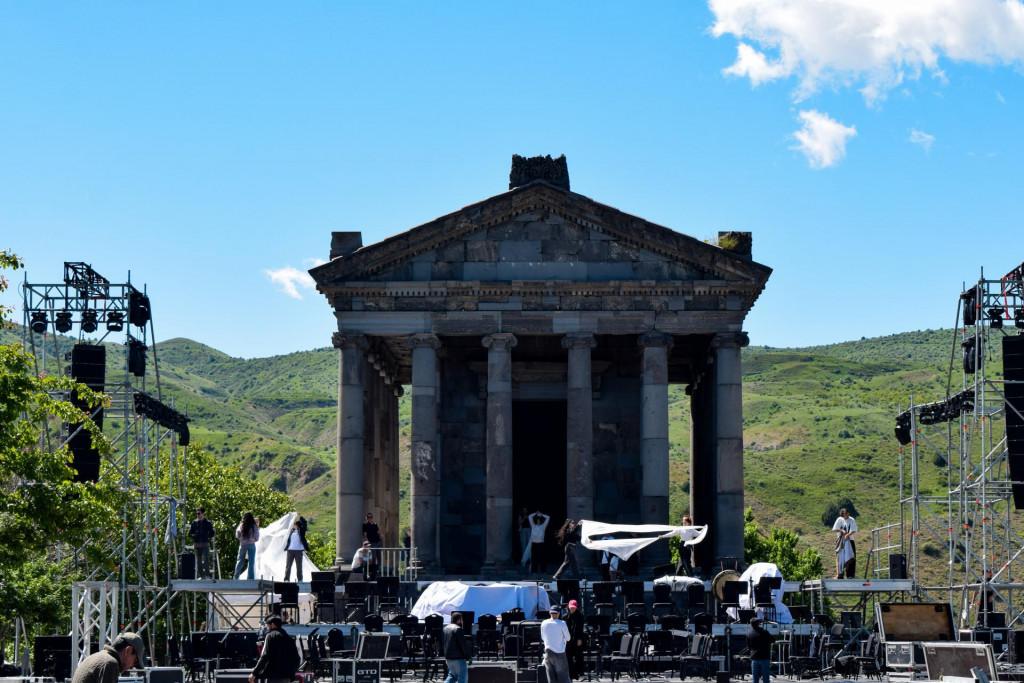
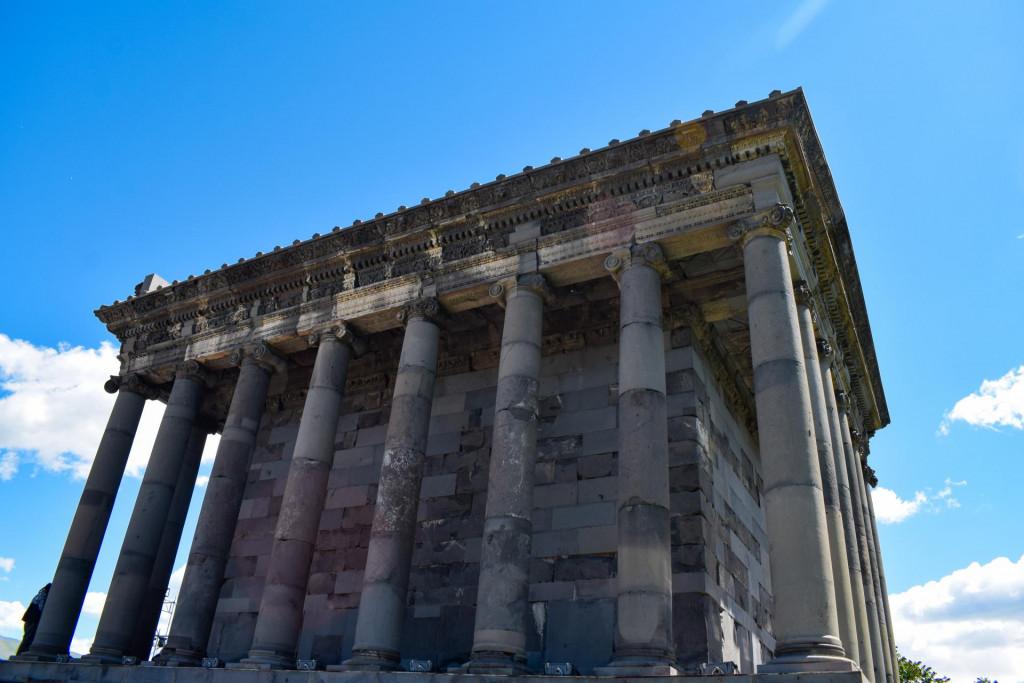
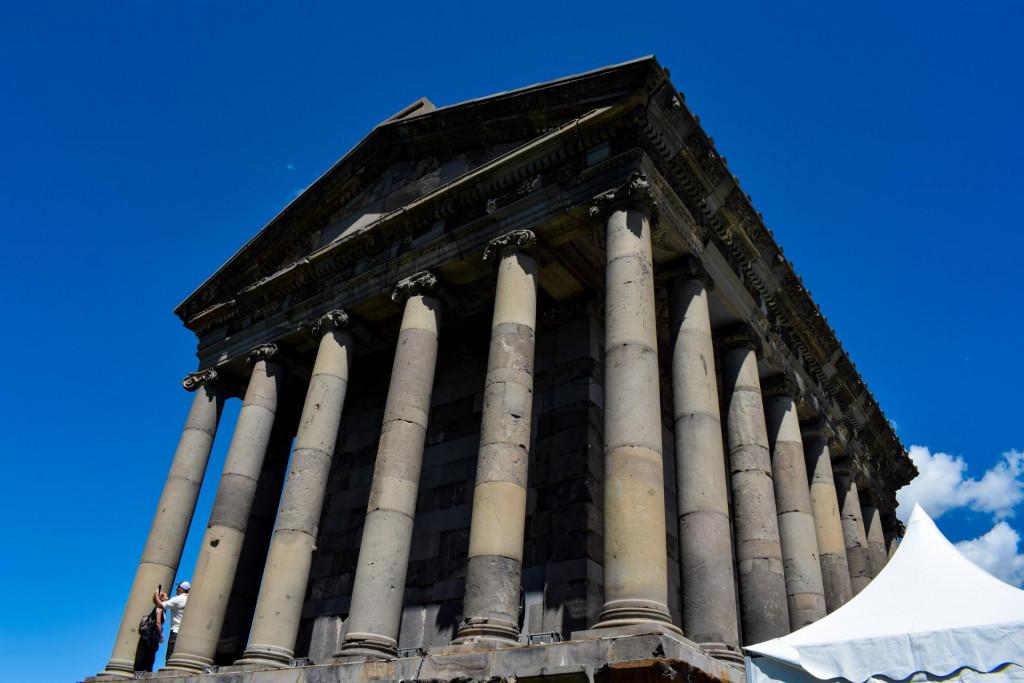
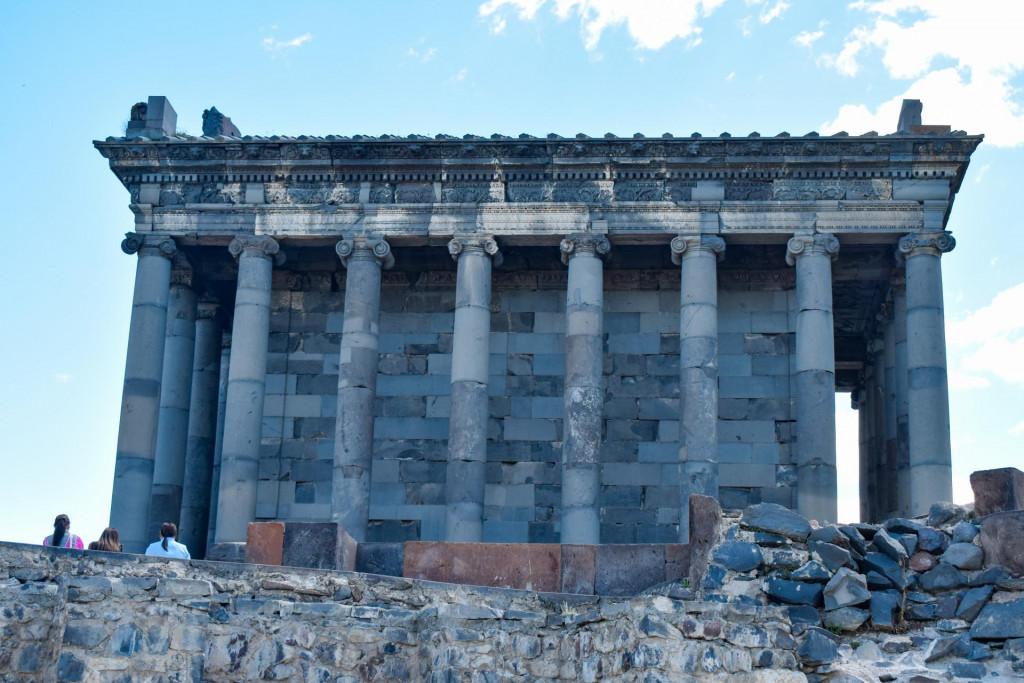
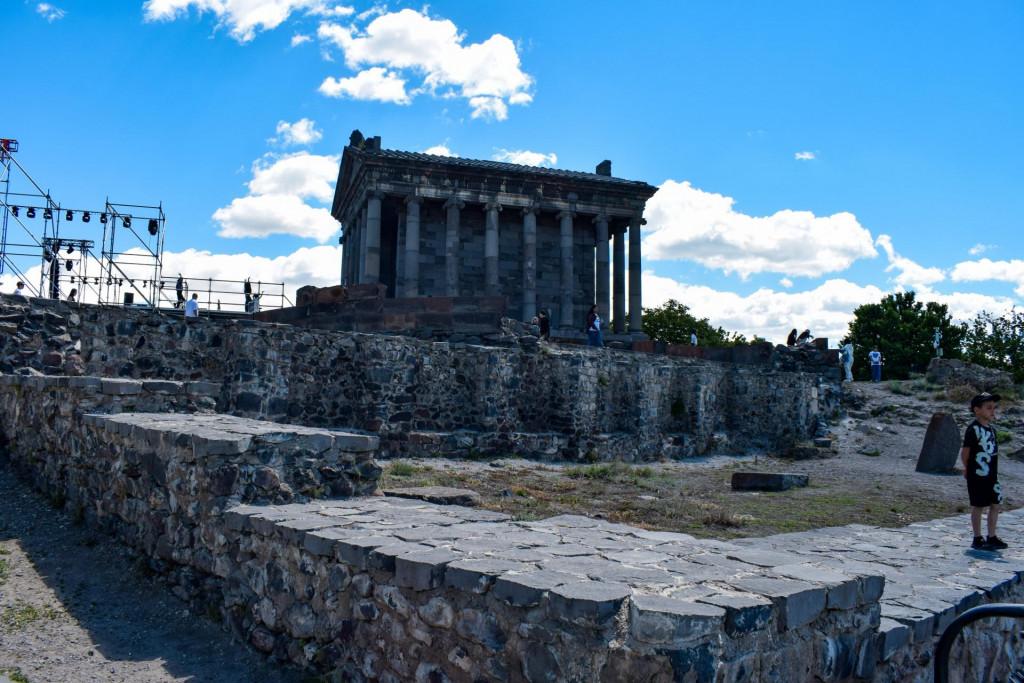
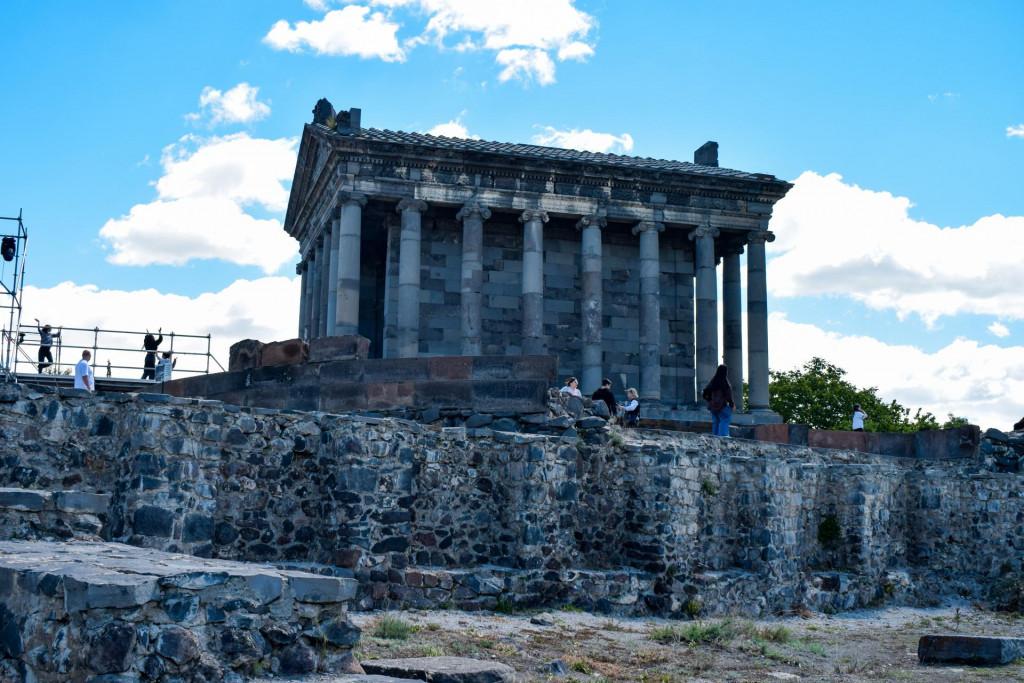
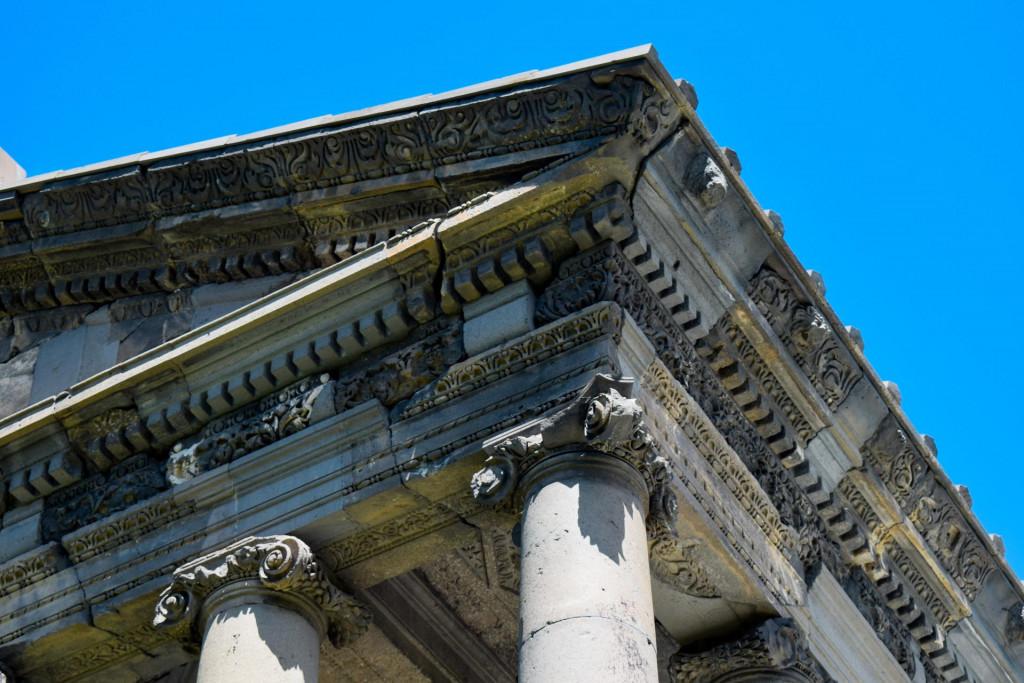
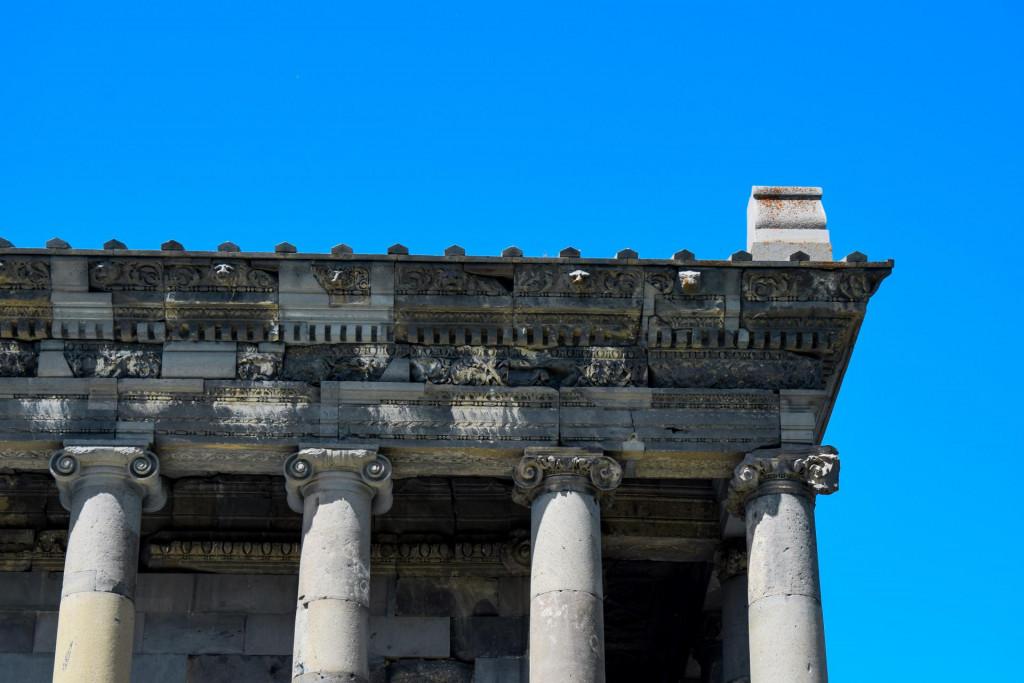
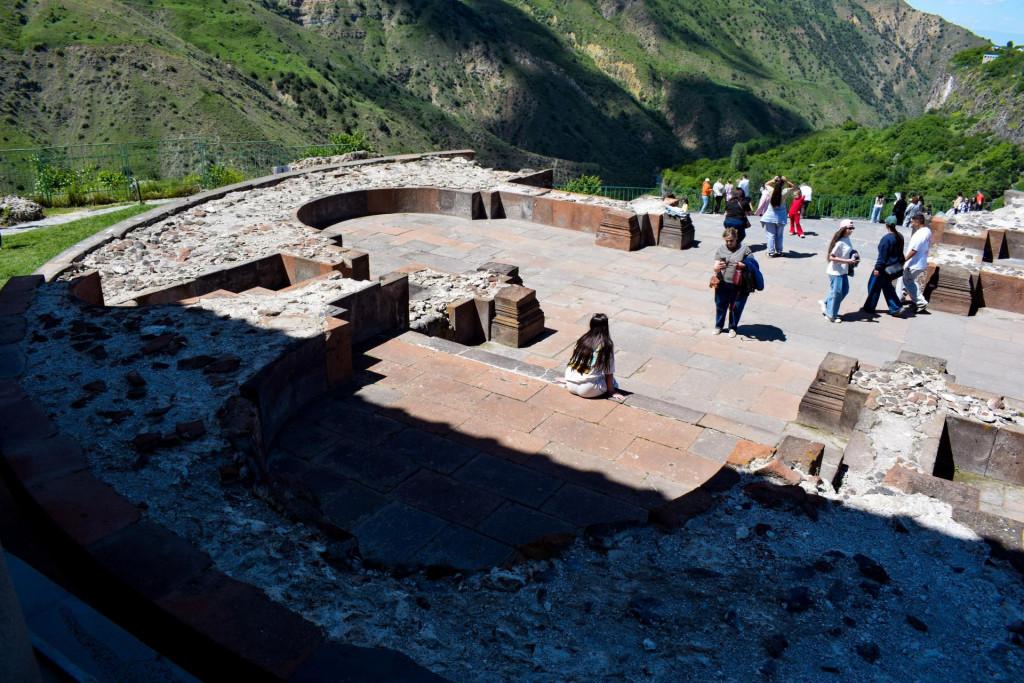
The Temple of Garni is a classical colonnaded (columned) building in central Armenia, about 30 kilometers east of Yerevan, in the village of Garni. Built in the Ionic order, this temple is the most famous symbol and architectural monument of pre-Christian Armenia. According to the traditional version, it is considered a pagan temple dedicated to the sun god Mithra (Mithra), built in the 1st century AD by King Thradat I. According to an alternative hypothesis, it is a 2nd century tomb. The temple collapsed as a result of a strong earthquake in 1679, although most of its fragments remained in place. Interest in it grew again in the 19th century, which was followed by archaeological excavations in the early and mid-20th centuries. The temple was completely reconstructed in 1969–1975, using the technique of anastylosis (reassembling the original parts). Today it is one of Armenia's main tourist attractions and the central shrine of Armenian neopaganism.
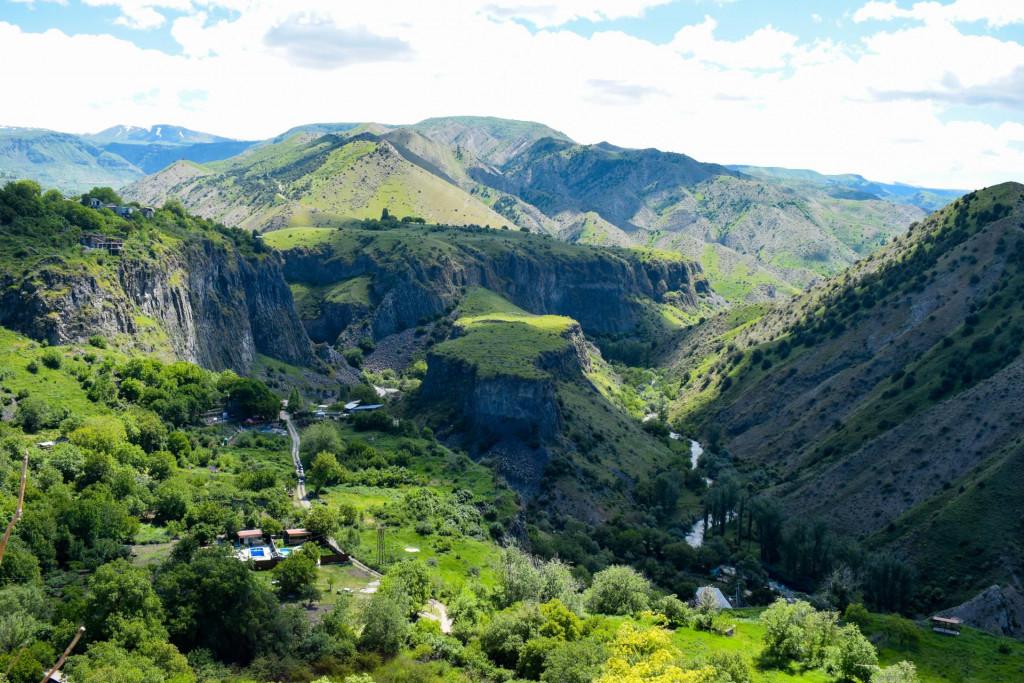
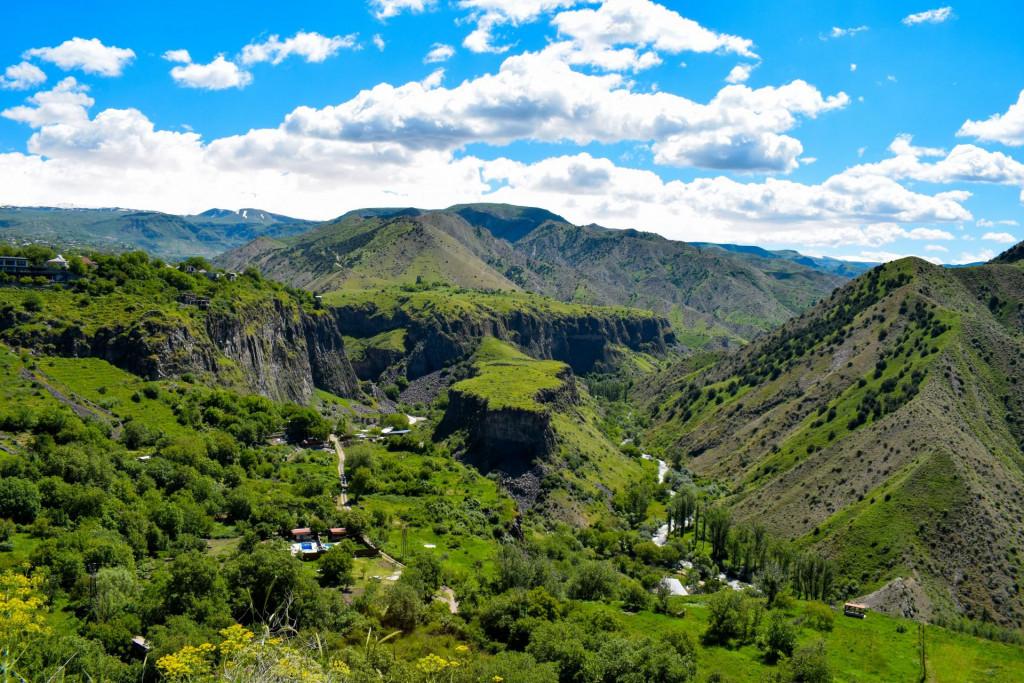
The complex is located in the Kotayk Province of Armenia, approximately 30 kilometers east of the capital Yerevan, at an altitude of 1,400 meters above sea level. The temple is built on the edge of a triangular-shaped promontory overlooking the Azat River valley. It is part of the Garni Fortress, one of the oldest fortresses in Armenia and of great strategic importance for the defense of the main cities on the Ararat Plain. In addition to the temple, the archaeological zone preserves a Bronze Age cyclopean wall, a cuneiform inscription of the Urartian king Argishti I (which calls this place "Gyarniani"), a Roman bath with preserved fragments of a mosaic floor with Greek inscriptions, the ruins of a palace, various attributes of the Greco-Roman world, the medieval round church of Saint Zion, and other objects (for example, medieval khachkars). In the 1st century, the Roman historian Tacitus mentions Garni Castle in his "Annals" as the most important fortress (castellum Gorneas).
The dating and function of the structure are still the subject of scholarly debate. Cristina Maranchi describes it as an Ionic structure of "uncertain function" and suggests that it may have been a monumental crypt or royal tomb rather than a temple. The remains of an older shrine have been found beneath its foundations, identified as a Urartian temple. The prevailing pagan temple theory, especially among Armenian scholars, attributes its construction to King Trdat I and dates it to 77 AD. This date is based on a Greek inscription discovered in 1945, which names Helios Trdat (Trdat of the Sun) as the founder and states that the temple was built in the eleventh year of his reign. Although Movses Khorenatsi attributed the building to Thradat III, most modern scholars support the version of Thradat I. This dating logically connects Thradat's visit to Rome in AD 66, where Emperor Nero crowned him king after concluding a peace treaty that ended the Parthian-Roman War for Armenia. Nero gave Thradat 50 million drachmas and Roman craftsmen to help rebuild the capital, Artashat, which had been destroyed by the Roman general Corbulo. It is likely that the construction of the Garni Temple began during this period of restoration work. In Armenia, it is generally accepted that the temple was dedicated to Mihr, the sun god in Armenian mythology (influenced by Zoroastrianism), who is the Roman equivalent of Mithras. Trdat, like other Armenian monarchs, considered Mihr his patron, so it would have been natural for him to dedicate the temple to him after his coronation in Rome. Scholars differ as to who built the structure: Telfer attributed it to Greek workers, Fetvajian to Roman architects, and Maranchi suggested the involvement of craftsmen from the Roman Empire. In contrast, Nersesian and Harutyunyan argued that local craftsmen skilled in basalt carving were responsible. Among the early skeptics, Camilla Trever in 1947 proposed that the building was built in AD 115–117, when Armenia was briefly declared a Roman province under Emperor Trajan, as temples were usually built to house statues of the emperor in such cases. However, she herself later concluded that if it had been solely for the cult of the emperor, it would have been demolished after the Romans left. In 1982, Richard D. Wilkinson proposed that the building was a tomb built around AD 175, in honor of an Armenian king who had fallen to Roman rule at the end of the 2nd century. This theory is based on comparisons with Greco-Roman structures in western Asia Minor (e.g., the Nereid Monument, the Mausoleum of Bellevue, the Mausoleum of Halicarnassus), the discovery of nearby tombs from the same period, and the discovery of fragments of Asiatic-style marble sarcophagi. Wilkinson also notes that there is no direct evidence linking the structure to Myrrh, and that the Greek inscription of Thradat I most likely refers to the citadel itself, not to this columned building. He also emphasizes that it is unlikely that the pagan temple survived the 4th century, during the Christianization of Armenia, when all other similar temples were razed to the ground. Wilkinson's theory has found some support, especially outside Armenia. Robert H. Huysen, based on the fact that in the 7th century the church was not built on the site of the temple, but next to it, believed that the building was more likely to be the tomb of a king appointed by Rome. History of the Middle Ages At the beginning of the 4th century, when King Thradat III declared Christianity the state religion, Gregory the Illuminator destroyed all the pagan temples in the country. Researchers consider Garni to be the only pagan, Hellenistic building that survived this general destruction. Scholars still argue about why an exception was made for it. According to Movses Khorenatsi, a "cooling house" (summer residence) was built in the Garni fortress for Khosrowadukht, at the request of the sister of King Thradat III. Some researchers believe that the temple was converted into a royal summer residence for this very reason. The building is likely to have undergone some changes: the cult statues were removed from the cella (inner hall), the light opening in the roof was closed, and the entrance was converted into a living space. There is also an opinion that after the death of Khosrowadukht (c. 325/326), it became his Christian mausoleum. Later, between the 5th and 7th centuries, the inner hall may have been used as a baptistery. In the Middle Ages, from the 7th to the 10th centuries, the round church of Saint Zion was built directly to the west of the temple. Six inscriptions in the Arabic Kufic style and one in the Persian Naskhi script have survived on the walls of the temple, dating from the 9th and 10th centuries. They are related to the capture of the fortress and may also indicate the temporary conversion of the temple into a mosque. At the entrance there is also a large Armenian inscription (1291), left by Princess Khoshak of Garni and her son, Amir Zakare — the inscription reports the exemption of the population of Garni from taxes (from taxes on wine, goats, and sheep).
The 13th-century historian Kirakos Gandzaketsi refers to it as the "wonderful throne of Trdat". The last significant written record of the temple before its collapse belongs to the poet Simeon Aparantz (1593), who in his lament laments the past glory of Armenia, describes the number of columns and steps of the temple, and notes the use of iron clamps and lead in its construction.
The entire colonnade of the temple collapsed during the devastating earthquake of June 4, 1679, the epicenter of which was in the Garni Valley. The building opened diagonally and fell to the northeast, scattering architectural fragments over a radius of 50 meters. The fact of the collapse is confirmed by the chronicler of the time, Zakaria Kanakerts. The temple has survived for more than sixteen centuries, which was due to its unusually strong construction for its small size and a massive podium. However, several decades before the earthquake, the structure had been significantly weakened by the wars of the Shah Abbas of Iran, when the iron brackets and lead cores for casting bullets were removed from the walls.
Nevertheless, in the 1870s, John Buchan Telfer took a fragment of the architrave with the image of a lion's head and bequeathed it to the British Museum, where it is kept to this day. In 1880, the Russian archaeologist Alexei Uvarov proposed the idea of transporting the stones to Tbilisi and rebuilding the temple there according to Montperre's plan. However, the governor of Yerevan, due to technical difficulties in transportation, rejected the plan and the project collapsed.
Early excavations Nicholas Mar led the first professional excavations in 1909–1911, together with Yakov Smirnov and the architect Konstantin Romanov. Camilla Trever later wrote that these were not archaeological excavations in the strict sense, but mainly involved the identification, cleaning, and cataloguing of fragments. The work was discontinued due to lack of funds. In 1940, the government of Soviet Armenia donated the Ionic capital of Garni to the Hermitage in Saint Petersburg, where it is still on display.
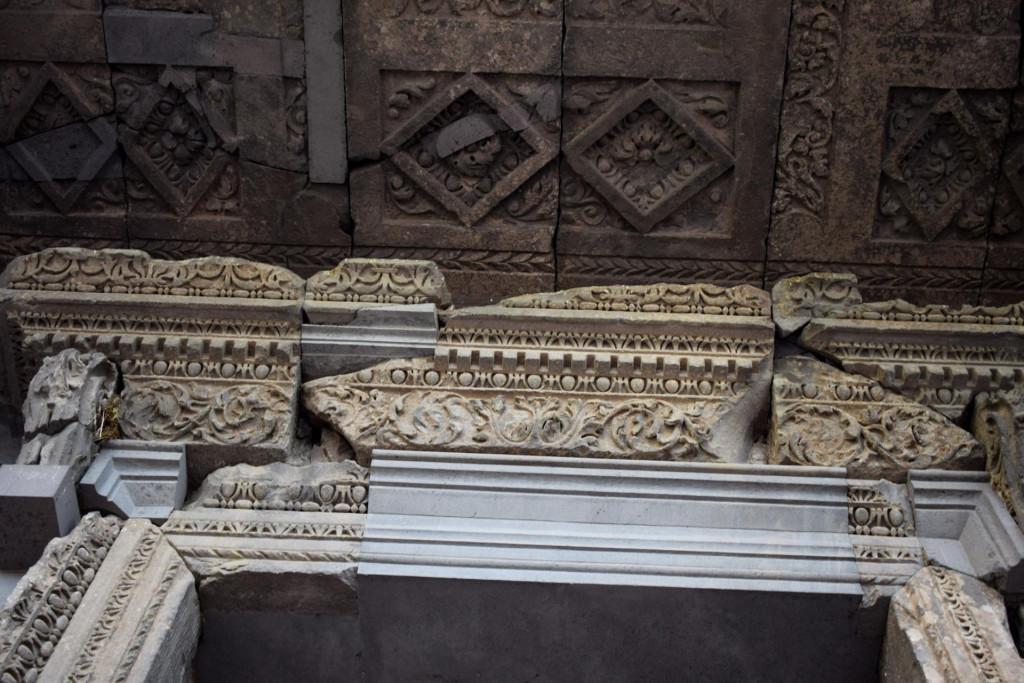
In December 1968, the government of Soviet Armenia officially approved the reconstruction plan, and Sahinyan's team began work in January 1969. The work was completed in mid-1975 — almost 300 years after its destruction by an earthquake. The temple was rebuilt using the original stones (anastylosis). The surviving parts made up about a third of the reconstruction, while the remaining two-thirds were filled with new material — basalt of the same color and structure, extracted from a local quarry. The missing spaces were deliberately filled without ornamentation, so that it would be easy for the specialist's eye to distinguish the old from the new. Most of the Ionic capitals were almost completely preserved (only two badly damaged ones were replaced with new ones). Only 40% of the column bases survived, only two of which, on the north facade, withstood the test of time. For the development and supervision of this project, Sahinyan was awarded the State Prize of the Armenian SSR in 1975, and in 1978 a monument-fountain dedicated to his memory was erected near the temple.
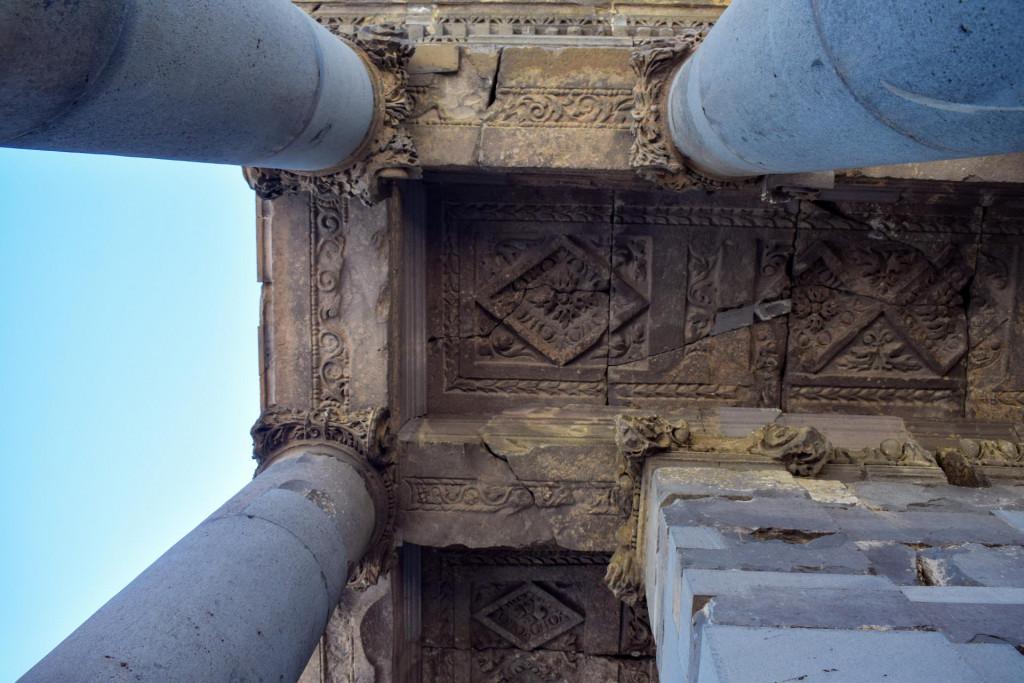
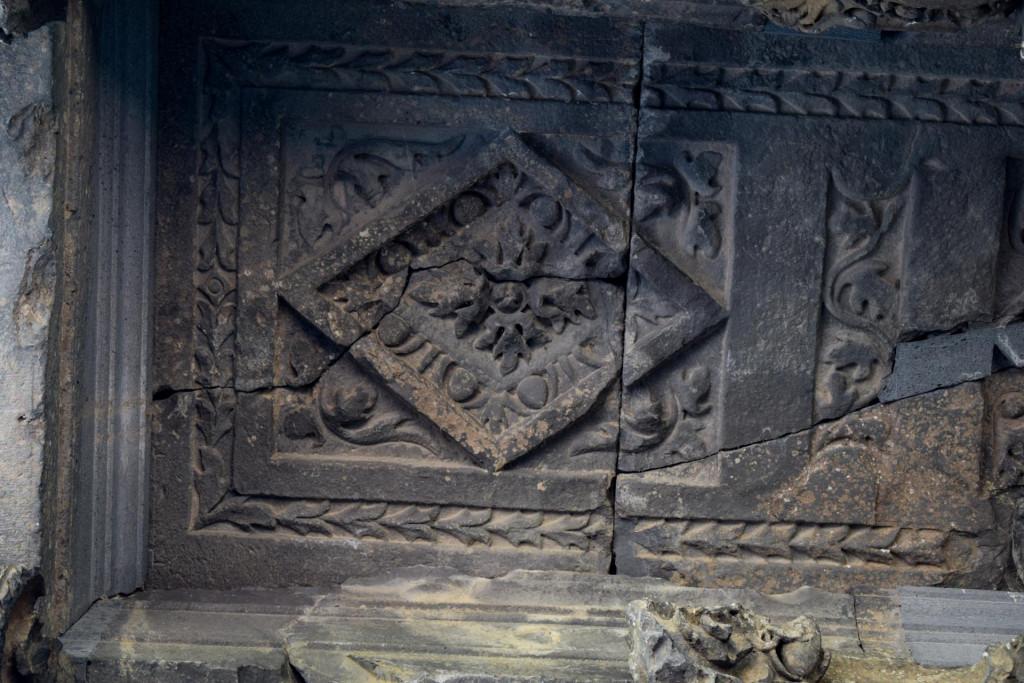
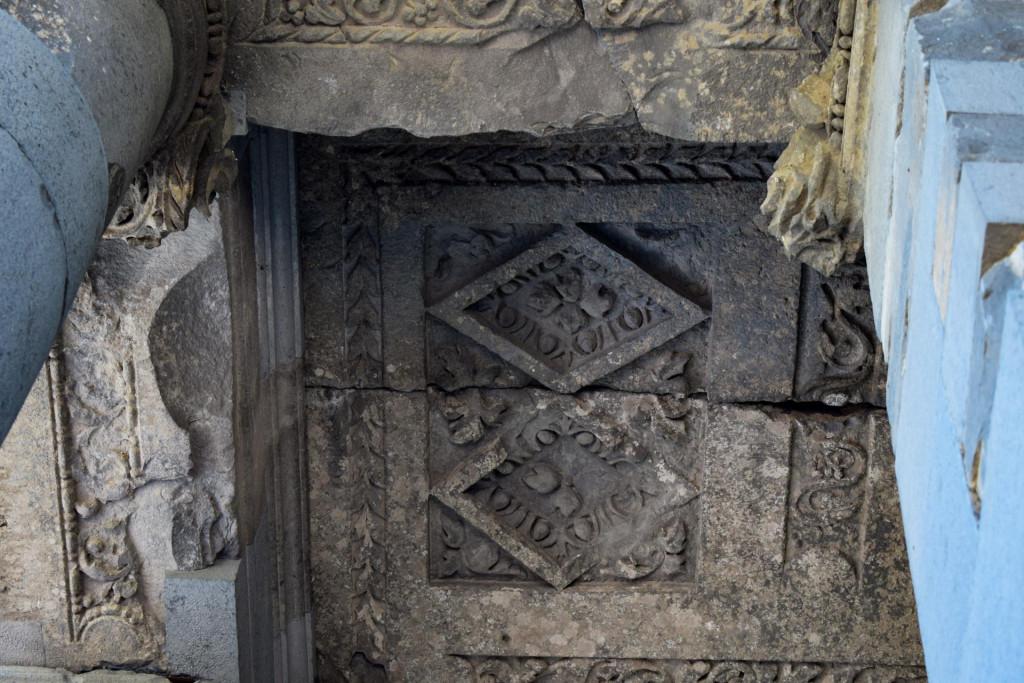
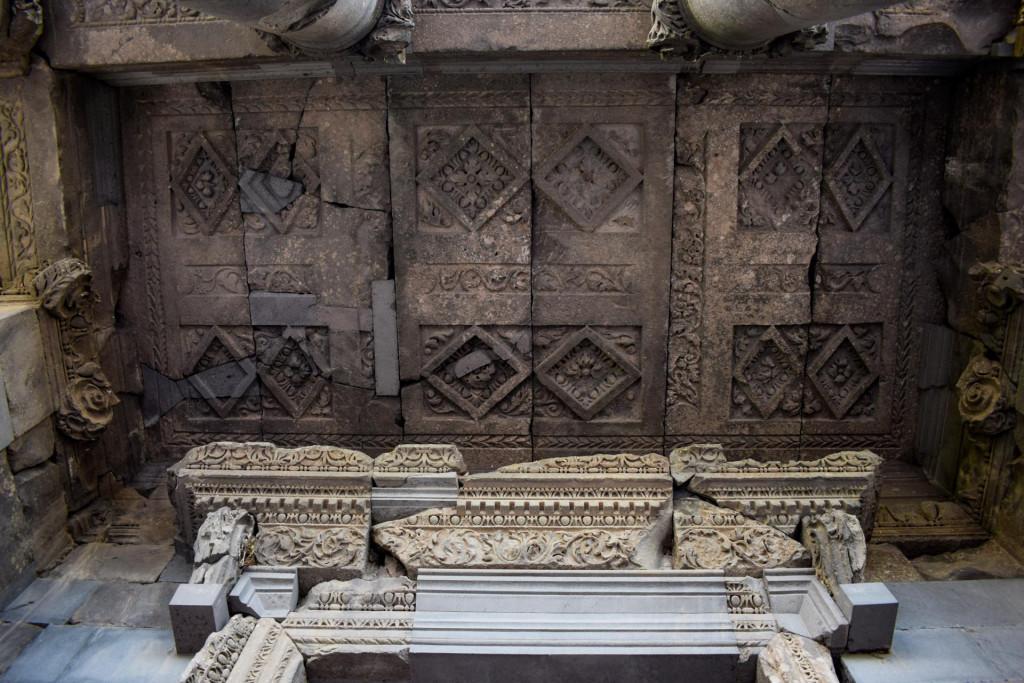
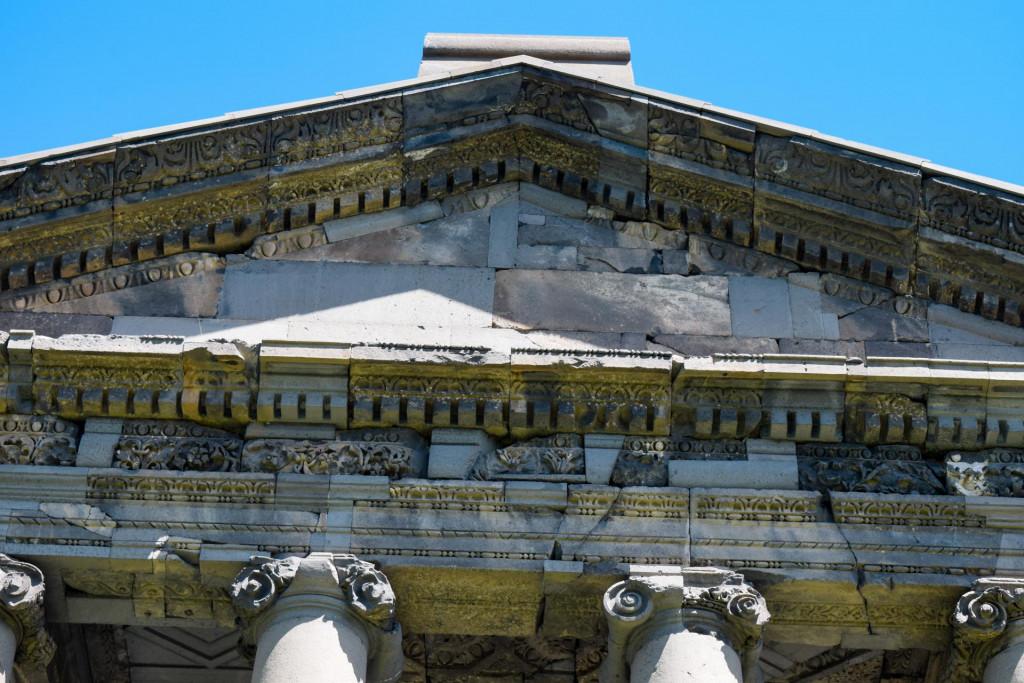
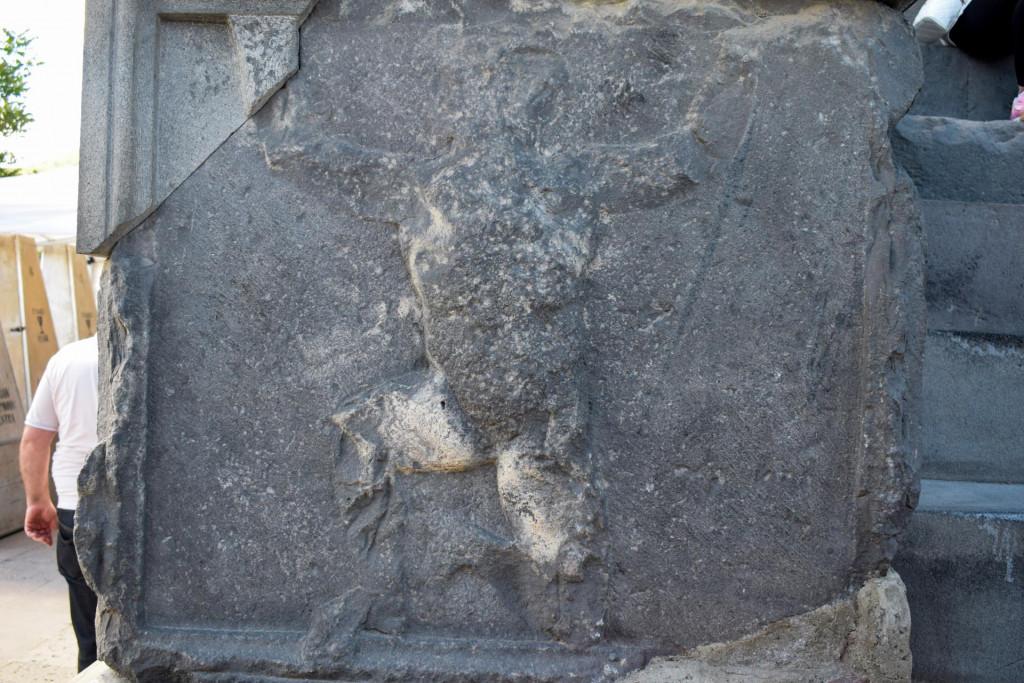
Unlike typical ancient temples, the facade of Garni is oriented to the north, not the east. On the north side, a staircase 8–8.5 meters wide leads to the hall. It consists of 9 steep steps, each of which is 30 centimeters high (which is almost twice the height of a regular step). According to researchers, such steps forced a person to make physical efforts when approaching the altar and to have a sense of humility. On both sides of the staircase are square pedestals (temptations), on which are carved reliefs of Atlantis - the Titan of Greek mythology, who carries the weight of the Earth on his back and here, as if holding the entire temple with his shoulders. Presumably, these pedestals were originally used to place altar tables. The exterior of the temple is richly decorated. Ornamentation is found on the capitals, architraves, and soffits (the lower part of the ceiling). The front cornice stones feature carved lion heads, a typical example of Asian mythological and architectural influence.
Garni is often cited as one of the most ancient examples of Greek architecture.
According to Justo Traina, the reconstruction of the temple by Soviet Armenian archaeologists was motivated by the desire to emphasize that the greatness of Armenia did not begin with Christianity. Along with the Urartian fortress of Erebuni, the restoration of Garni was actively supported and promoted by the communist leaders of Armenia. The reconstruction of Garni coincided with the period of national awakening in Soviet Armenia in the 1960s, after which it became a symbol of national pride, and the restored monument became the main decoration of various holidays and cultural events.
Its status as a symbol of Armenian antiquity was further strengthened in independent Armenia.
In March 2025, Armenia nominated the "Garni Archaeological Complex and the Basalt Organ" (known as the "Symphony of Stones") to the UNESCO World Heritage Tentative List, aiming for its future recognition.

Our guides are ready to help you on this trip


Help other travelers use your experience.
Review this destination, share your thoughts, impressions, pros and cons.
Let's make traveling easier than ever.
 LOGIN WITH GOOGLE
Please login to ask a question
Ask a Question