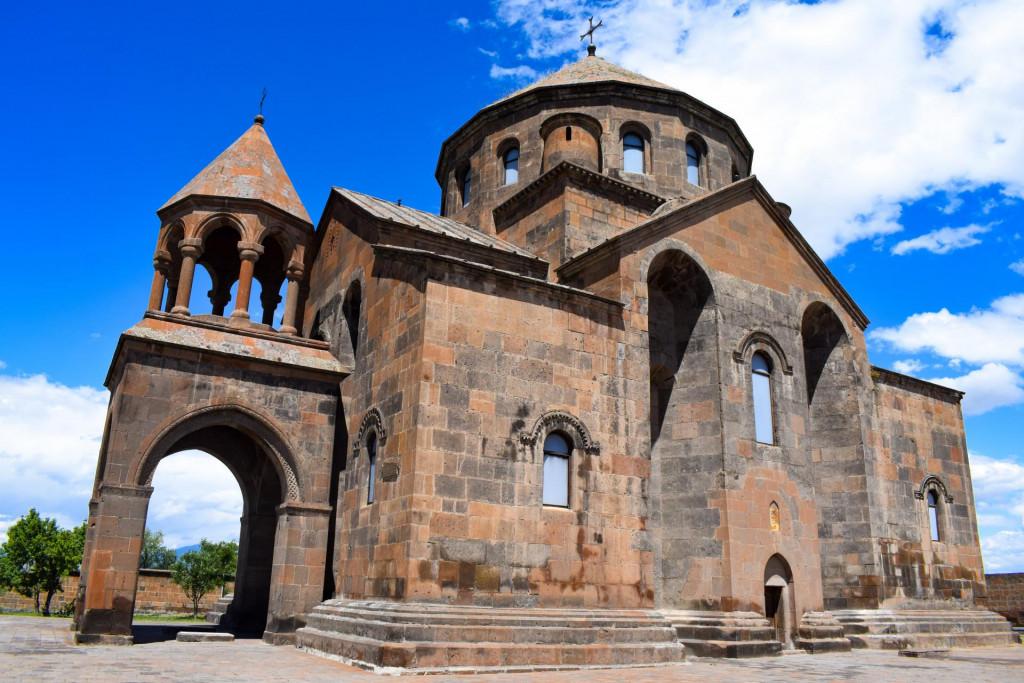
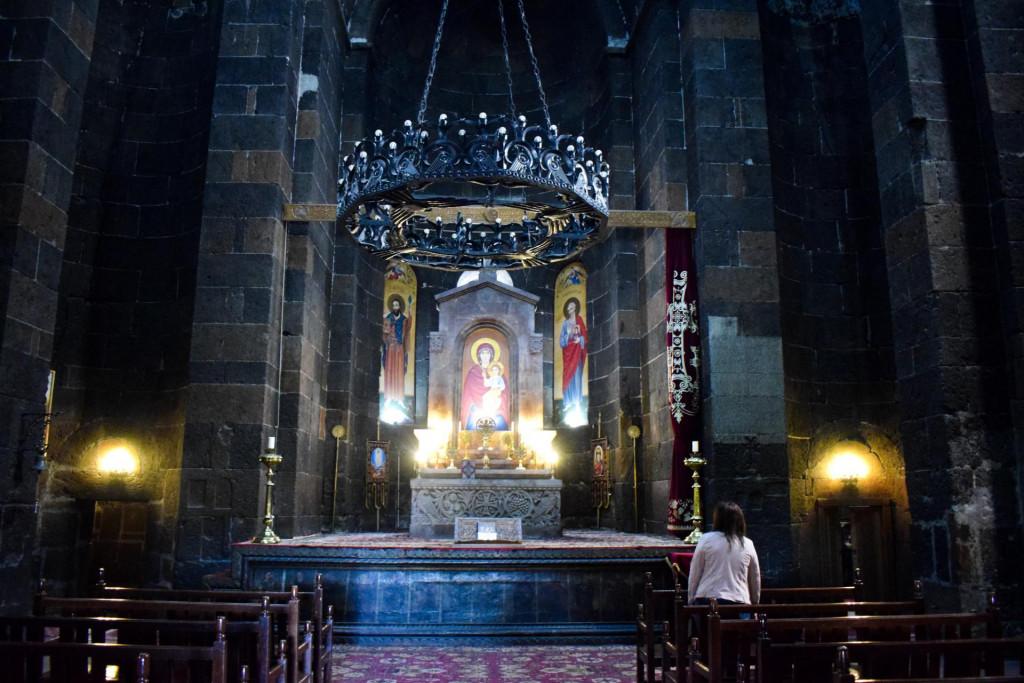
The Church of Saint Hripsime is a 7th-century Armenian Apostolic church in the city of Vagharshapat (Echmiadzin), Armenia. It was built in 618 by Catholicos Komitas over the tomb of Hripsime, a Roman virgin and one of the most important figures in the Christianization of Armenia.
The church has survived almost intact since its construction. It is considered a masterpiece of classical Armenian architecture and has influenced many other Armenian churches. The building is distinguished by innovative elements, namely: trapezoidal niches and conical trumpets (the first dated examples of which are found here), a windowed dome neck, and the only example in Armenia where small towers (panchaturs) at the base of the dome neck serve as anchors and buttresses (supports). The two inscriptions left by Komitas represent the second oldest Armenian-language inscriptions that have survived to this day.
The church is located on a small natural hill on the eastern outskirts of the city of Vagharshapat (Echmiadzin), near the main road connecting the city with the capital Yerevan. It stands on an open plain and was built outside the historic walls of old Vagharshapat, although it is now in an urban environment.
Pre-Christian remains
Excavations inside the church in 1958–59 revealed three fragments of black tuff, which belonged to an ornamented Ionic cornice and were placed upright under the supporting columns. These fragments were immediately attributed to a pre-Christian Hellenistic structure, stylistically similar to the cornice of the Garni Temple. Some researchers, including Alexander Sahinyan (who led the excavations), have argued that these fragments indicate the existence of a pagan temple at this site. Others believe that they were brought from another site in Vagharshapat and reused in the foundation of the church.
According to the traditional account recorded by Agathangelus, the Roman virgin Hripsime and her companions (including Gaiane) fled to Armenia to escape the persecution of the Roman Emperor Diocletian. In Armenia, Hripsime was tortured and killed by King Thradatus III after the virgin rejected his feelings. After Thradatus converted to Christianity in the early 4th century (301 or 314), he and Gregory the Illuminator built a martyrium on the site of her martyrdom as a sign of repentance. Agathangelus notes that Thradatus had huge stones brought down from Mount Ararat to build the martyriums of Hripsime and her companions. This structure, considered one of the earliest Christian martyriums, was partially buried in the ground and had a roof over it. It was destroyed around 363 by the Sassanid king Shapur II and his Armenian Zoroastrian ally, Meruzhan Artsruni, along with the Echmiadzin Cathedral and other Christian shrines.
In 395, Catholicos Sahak Partev built a new chapel-martyrdom. Archaeological excavations conducted in 1976–78, approximately 10 meters east of the current church, revealed the foundations of a small single-nave basilica, which is likely the remains of this late 4th-century structure. It is noteworthy that Christian burial remains were discovered nearby, which researchers and the Armenian Church considered to be those of Hripsime and his fellow monks. A document from 608 preserved in the “Book of Letters” mentions a priest of the church of St. Hripsime, named Samuel, which proves that the chapel was active at that time.
Catholicos Komitas' inscription on the west facade, photographed by Garegin Hovsepian in 1913. The same inscription from ground level, which is partially covered by the bell tower.
The second inscription of Komitas in the apse.
The 7th-century historian Sebeos tells us that Catholicos Komitas (r. 615–628) demolished the old minor martyrium and built the present church in the 28th year of the reign of the Sassanid king Khosrow II, which is calculated as 618, and this date is almost unanimously accepted. Vagharshapat was under Roman (Byzantine) rule at the time. Two inscriptions attest to Komitas' role in this construction.
The church has two carved inscriptions in the circular (Erkatagir) script. These texts, dated to 618 and 628 respectively, are the second oldest known Armenian inscriptions after the Tekor Church Inscription (c. 478–490).
The first inscription (202 × 60 cm) is located on the exterior of the west wall and is now largely obscured by the bell tower. It reads: "I, Komitas, sacristan of the church of St. Hripsime, was called to the throne of St. Gregory. I built this church for the holy martyrs of Christ."
The second inscription (150 × 35 cm) is found in the interior of the eastern apse, behind the altar. It was discovered under the plaster during the restoration work of 1898, during which it was slightly damaged. The inscription asks Christ to appreciate the work of Komitas: "Christ God, remember Komitas, Catholicos of Armenia, builder of Saint Hripsime."
Not much is known about the history of the church during the Middle Ages. The 10th-century Catholicos John Draskhanakerts described it as a magnificent and magnificent building. Inscriptions indicate that the church was used intermittently. For example, an inscription from 1296 reports the exemption of the monastery from the tithe of cotton and other taxes by local rulers, while an inscription from 1302 on the wall of the western entrance records a donation of 1,000 silver coins.
The chronicler Arakel Tabrizi describes the condition of the church at the beginning of the 17th century and provides details of its restoration (along with Saint Gayanes) by Catholicos Philip (1633–1655). After Shah Abbas deported the Armenians to Iran in 1604–05, the church was left “without inhabitants and without fences.” The abandoned and unprotected church was severely damaged by that time. During the period of neglect, stones were also stolen from the church. Arakel reports that the church had no doors, the altar, roof, and walls had collapsed, and the foundation was shaken and dug up; the interior was filled with manure, as cattle were kept there. According to him, in 1610, two Catholic Augustinian missionaries stole the holy relics of Hripsime, which caused great indignation among the Armenians. With the help of Shah Abbas I of Persia, the relics were recovered and returned.
The restoration of the Cathedral of St. Hripsime under the leadership of Catholicos Philippos took three years—work began in 1651 and was completed in 1653, at great expense and with enormous labor. This restoration included the pediments, the dome roof, and also the construction of an open doorway/narthex in front of the western entrance (on which a bell tower was built in 1790).
After the restoration of 1653, the church had a permanent parish. Subsequent Catholicos Eghiazar (1681–1691) and Nahapet (1691–1705) further contributed to its revival: they added auxiliary buildings and financed the creation of manuscripts. Six inscriptions carved on the walls in the 1720s record donations of salt, oil, incense, rice, candles, and wine. In the 17th and 18th centuries, the monks of St. Hripsime were supplied with bread and clothing by the Etchmiadzin Monastery, although the monastery also had its own arable land and livestock.
The portico and bell tower, which were added in 1653 and 1790 respectively.
Later additions and restorations
In the early 1930s, the church was renationalized and, together with the adjacent buildings, was converted into the Vagharshapat Archaeological Museum, a repository of antiquities. After the restoration in 1936, the church itself became a museum, housing various archaeological exhibits from the nearby Zvartnots Church (including an Urartian inscription), pottery from Karmir Blur, two Ionic capitals from the Garni Church, frescoes from the destroyed Church of Saints Peter and Paul in Yerevan, and others. The museum functioned for almost ten years. The church and monastery were returned to the Mother See in the spring of 1945, after the Catholicos-at-Large, Gevorg Chorekchyan, appealed to Joseph Stalin. More than 110 exhibits from the museum were largely transferred to the History Museum of Armenia.
In 1958, work shifted to the interior: the white plaster and lime were sandblasted away, revealing the original dark grey-brown tuff walls and a system of 8 large and 16 small trompe l'oeils beneath the dome's throat. Excavations in 1959 revealed the original floor, which was 40 cm below the then-current level. The floor level was lowered to the original level.
Tomb of Saint Hripsime
The tomb of Saint Hripsime is located in an underground vaulted crypt, under the eastern apse. The entrance to it is from the chamber in the northeast corner.
Ornamentation
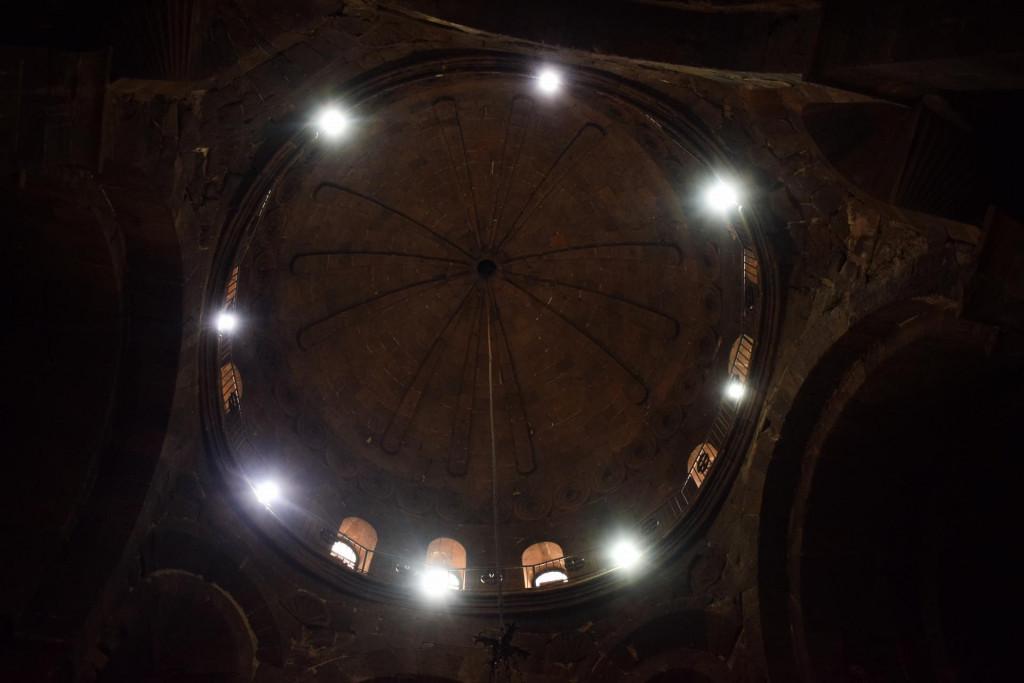
The church is characterized by minimalist decor. The decoration on the exterior is mainly limited to sculptural arched friezes above the windows, which are stylized with plant and geometric motifs. Inside, 32 simple medallions (rosettes) consisting of concentric circles run along the neck of the dome. The dome chamber itself has 12 relief rays radiating from the center, forming a cross-shaped shape. This design has been linked by scholars to the mosaic cross of the dome of Hagia Sophia in Constantinople, as well as to solar motifs in Sasanian architecture.
Dome and Trumpets
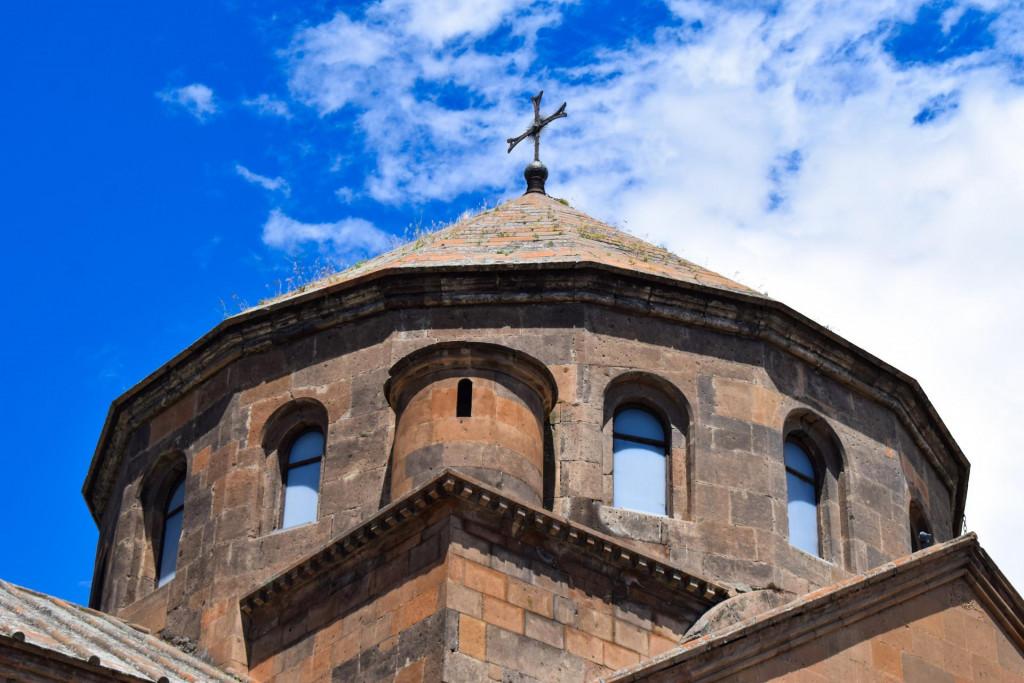
Its dome is considered the pinnacle of Armenian architecture. The windowed dome is a significant innovation, emphasizing the vertical aspiration of the building. The dome rests on a slightly rectangular space (10.10 m × 9.52 m) and is covered by a conical roof, which sits on a low, 16-bay, 12-windowed dome. The dome is unusually large compared to the size of the church.
Restoration in the 1950s confirmed the dome's 7th-century origin, as it bore the same signs of stonemasonry as the main body of the church. Mnatsakaniani suggested that the original dome had a spherical, tiled roof, and that only its exterior was renovated in the 1650s.
The transition from the square space to the circular dome is made by four large corner trumpets and eight small trumpets above them. This type of conical trumpet has no precedent in earlier, precisely dated Armenian buildings. Some scholars associate them with Sassanid architecture, although Cristina Maranchi has shown that the similarity with Iranian examples is only superficial and the construction techniques are different. In her opinion, much more convincing parallels are shown by Cappadocian churches (in particular, the Kızıl Kilise - Red Church).
This specific plan is often called "Hripsime-type" architecture and is shared by a group of churches in Armenia and Georgia. The most important examples are St. Hripsime itself and the Cathedral of the Cross in Mtskheta, while the Church of Avan (590s) is the earliest dated example and model for Hripsime.
This plan is often described as the most distinctly Armenian (or Caucasian) architectural form. Other churches with a similar plan in Armenia are Garnahovtsi, Artsvaberi, Soradiri (Zoradir), Targmanchatsi, Sisian, Aramus. In Georgia, this type is repeated in the Athenians' Sion, Old Shuamta and Martvili. In the 10th-11th centuries, this design was revived in the Holy Cross Cathedral of Akhtamari, the Church of the Apostles of Anisi, Varagavank and Gndevank.
Although the question of priority has been a subject of debate among Armenian and Georgian scholars, these monuments are part of a mutual influence and a common cultural heritage. Karen Balian has called the churches of Hripsime and Jvari "works of genius" and has called the dispute over "typological primacy" between them a manifestation of narrow-mindedness. Edith Neubauer has described Hripsime and Jvari as "classically perfect endpoints of centuries of development in both countries."
------------------------
According to "The Conversion of Kartli", Rhipsime was a Roman noblewoman, "the king's vassal," or relative.
Nino was fourteen years old when a certain woman from Ephesus, who served at the Roman court, arrived in Jerusalem. According to this woman, the Romans had a great desire for the law of Christ and baptism. Because of this, Nino decided to go to Queen Helena to preach the law of Christ. With the blessing of Patriarch Juvenal, Nino set out with the woman, and when they arrived at her house, she saw there a certain noble woman, a relative of kings, named Hripsime, who had a desire to confess Christ and was waiting to be baptized from Jerusalem. Then Hripsime and forty souls of her household were baptized under Nino's hand and remained in her house for another two years.
By this time, Emperor Constantine and his mother, Helen, had already confessed Christ. Therefore, it is unclear why Hripsime and her nurse, Gayane, fled with Nino and fifty other souls from "Greece", that is, from the Roman Empire. It should be correct to assume that at that time they were in the eastern part of the empire, which was ruled by Licinius, the persecutor of Christians in 313–324. We must assume that the holy virgins fled from Licinius' persecution to Armenia, where they arrived, presumably on March 15, 317 ("the first fifteenth of Titus"; March was considered the first month of the year in the Roman Empire), and believed on March 30 in the garden of King Thradas. Of the virgins, only Nino survived, who hid in the rose bushes.
It must be correct to assume that the route of the refugee virgins from the Roman Empire to Armenia included the Black Sea. In the part of the "Conversion of Kartli" called the chronicle, we read: "When the river Ri[p]sim crossed the sea, Ga[a]ne and Nino and some others with them went out to the Armenian lands, where King Thrad was. And they were martyred there." Accordingly, the martyrdom of the virgins must have taken place in the western part of the then Armenia, near the borders of the Roman Empire. The Armenian tradition that the torture of the "Ripsimeans" took place in Vagharshapat, or in present-day Etchmiadzin, must clearly be a later fabrication, since the Kingdom of Kartli, and specifically Lake Paravan, is located northwest of Vagharshapat, and in no way east of it. This discrepancy was not noticed by the author of the "Lives of the Kings" and the words of the "Return of Kartli" - "I arose and went eastward" - were corrected to: "I arose and went northward." As it turns out, the place of the torture of the "Ripsimeans" should not have been Vagharshapat, but the city of Vagharshavan, located in the upper reaches of the Araks River in the Basian region, from which Lake Paravan is indeed eastward.
According to legend, St. Hripsime fell in love with Thradat III. But when he asked her to marry him, she refused because she was a Christian. For this, the Armenian king cut out Hripsime's tongue and ordered him to be stoned to death, and his friend Gayane was dismembered and eaten by tigers.
The Armenian Church canonized Hripsime as a saint and established June 4 as his memorial day.

 GEO
GEO  ENG
ENG  RUS
RUS 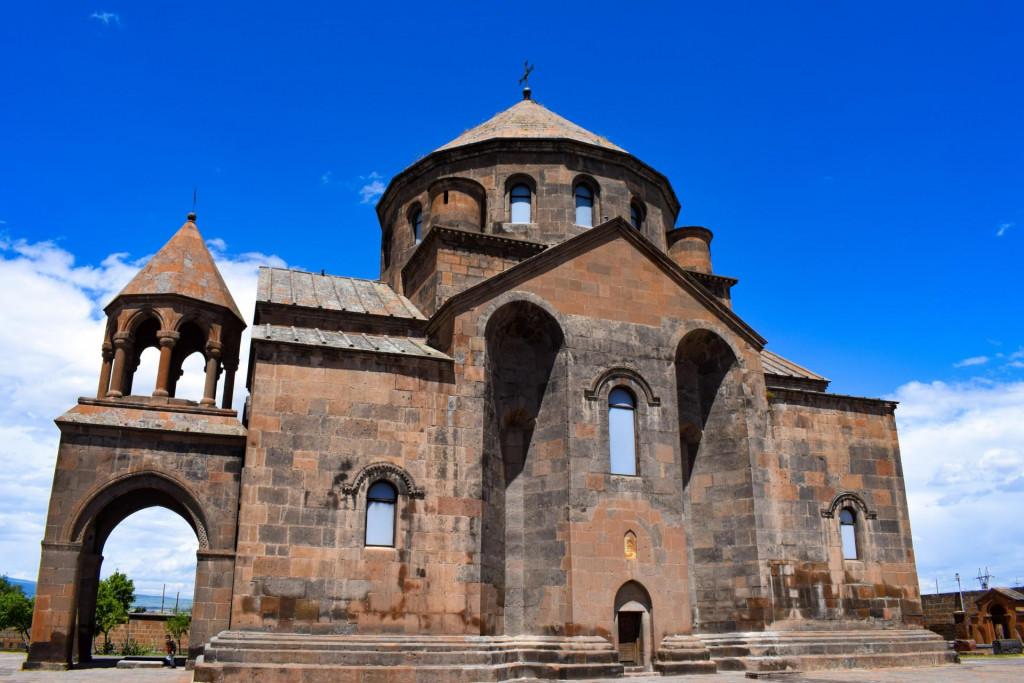








 LOGIN WITH GOOGLE
Please login to ask a question
Ask a Question