Once, while talking to hikers, when we were discussing the Toba-Varchkhili route , I insisted that this route is not difficult at all and that its incorrect assessment is due to the fact that most of those who go on this route are beginners and the mass creates the opinion that Toba-Varchkhili is the most difficult route in Georgia. Without going into too much detail, I convinced the interlocutors that the mentioned route is very easy and the myths about it are exaggerated. After a few minutes, one of the hikers asks me:
- How many years have you been hiking?
- Three... but I'm in the mountains every weekend.
- And what was the most difficult route during these three years?
- ... Lakumurash Toba ...
It sounded a bit ridiculous after my insistence on the simplicity of the Toba routes . This made me think and realize that the route itself cannot be the determinant of difficulty. The difficulty of a hike is determined by many details, the most important of which are: the experience and readiness of the hiker, proper equipment, season, weather, the psychological state of the hiker, and more. An experienced hiker will agree that sometimes it is easier to climb the glacier than the Abudelauri lakes. This is very good news for those who love difficulties. It turns out that in order to complete a difficult route, it is not necessary to set out on the path to the glacier with expensive equipment, but it is enough to climb the forest paths from our house to Kojori in the coldest, windiest, and snowiest weather of winter.
This story began exactly like this, one fine day, the almighty Nika and I decided to visit Lakumurash-Toba in two days. Our camp was located 4.5 kilometers from Natifuru, at an altitude of 2000 meters above sea level. Ahead of us were 5 passes, each of which was at least 2800 meters high. We were in no hurry, because we were too confident in ourselves. Nika, tired from the previous day, woke up at 8 am, we filled up with food and started walking at 9 am. In 1.5 hours we were already at Tsashkibuli Toba , but we did not stop there, we crossed the second pass without stopping, bypassed the Silver Lake and rested at Kalalish Toba . We replenished our energy and at 13:45 started walking towards the impassable rocks of Lakumurash. We were going to take a short cut and turned off the trail and headed straight towards the rocks, hoping to find somewhere to climb, but unfortunately there was none. The only chance to safely descend from Kalalish Toba to Khobistskali Gorge is the trail that leads to Tsakatskari Toba and then turns sharply to the left, towards the Khobistskali River Gorge. After about an hour of climbing, we threw down our shields and swords and followed the trail into the Khobistskali Gorge, from where we had no choice but to either abandon the trail again and try to climb Lakumurashi by a short cut, or descend to Khaishi and continue our route for 2 days. Of course, we preferred to take the short cut, crossed the river in a strange place using strange equipment and climbed the fourth pass in a row. We were walking up to our waists in the grass, in the terrible heat, on the most difficult climb, surrounded by blood-sucking flies. It was a climb that we climbed without a word. It was very difficult for both of us, but we did not say a word until we reached the top. It turned out that after this terrible fatigue, we climbed the fourth pass in a row, which was 3 km long and 800 meters high, in an hour and a half, and we said then that even Chuck Norris would have difficulty repeating this record in such conditions.
At six in the evening we descended from the pass into the Svaneti valleys, following the ridge on which our highest peak rose and thanks to it we were able to hold on to the vertical rocks. After an hour of descent, we decided to take a shortcut and cross the river. Here we were lucky for the first time, later it turned out that we crossed the river exactly where we needed to, because the impassable rocks a little lower or a little higher made it impossible to escape. After the river, we joined a 2-meter thick grass, where it was impossible to see where we were going or what we were stepping on. In addition to everything, insects competed with the sun in drying our blood. Here at one point a stick knocked me into the stones, because I had not removed my snow tires and it got stuck in the stone. I hit my knee quite hard, so that for the next 1 hour my leg was shaking. I still remember this trauma from Lakumurashi and it always reminds me that 1 extra minute spent now can be worth months saved in the future. This applies to the snow protection rubber left on the poles.
We went all the way down the river valley and the beautiful and impassable rocks of Lakumurashi spread out before us. We had no idea where we could get to this seemingly inaccessible lake, and here we were lucky for the second time, when the intuition of Almighty Nika dictated that it was better to take a long way than to take a short hike. Thus we passed the forest and reached the far right edge of the valley descending from Lakumurashi, from where we followed the riverbed emerging from Lakumurashi. It was already half past seven, but the insects and the sun still did not let us go. We were slowly moving forward, this was already the fifth pass we were climbing. There was a chance that we would not reach the lake, so we were in a hurry, but we no longer had the sense of speed. Here Almighty Nika felt dizzy and nauseous. I didn't feel like a bird either, so we took a break, mixed condensed milk with water, and poured it straight into our brains instead of our stomachs. When we woke up a little, we continued on our way.
It was already nine o'clock and we still had no idea whether we were going the right way or not. But here, the fatigue of the whole day, the heat, the flies, the little time left, and the lack of knowledge of the location of our destination took a psychological toll, and we were already desperately searching for a way to the lake.
And then a miracle happened, we reached the cliff, from where it was clear that the only way to climb up was to climb the cliff. That is, the most difficult path awaited us ahead. Many people probably would not have taken such a risk when they were so tired and would have preferred to rest, but I noticed a sparkle in the eyes of the almighty Nika. I realized that now he wanted to climb the cliff more than ever and this passion carried me too, we forgot everything, fatigue, heat, hunger, insects.... We left everything behind and started climbing with our giant bags, we climbed without stopping and without looking back. In a few minutes we reached the top of the cliff and our hearts were broken that this amazing section had ended so soon. And here we were, exactly at 8:36 in the evening, already standing on the shore of the lake, amazed... What we saw there is impossible to convey in words, you have to see it with your own eyes. This is a place where you forget all your problems, a place that is completely different both visually and in terms of natural conditions from all the other places around, a place where even your phone can be reached...
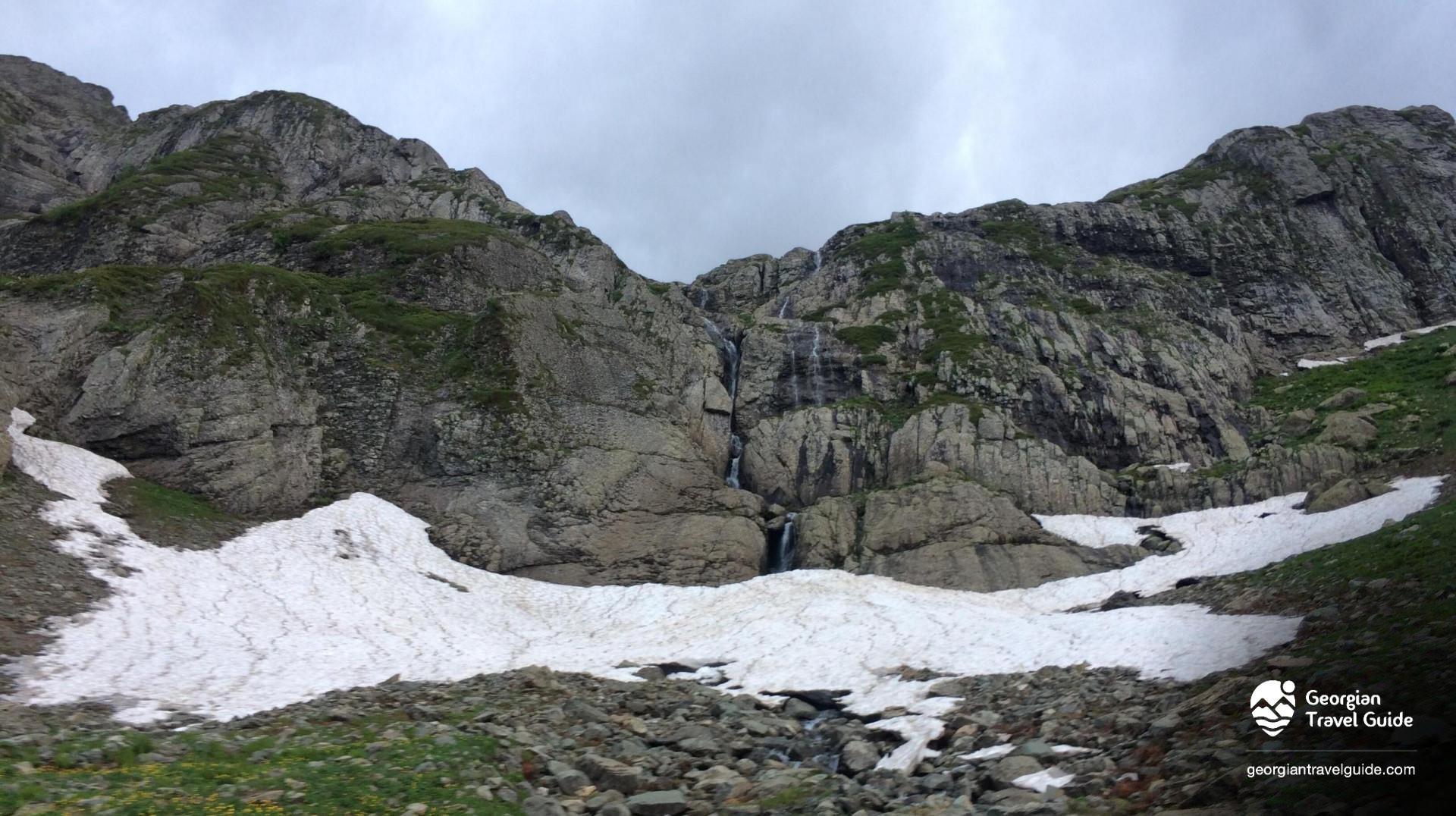
Lakumurash-Toba is surrounded by huge cliffs with a negative slope, creating an amazing picture. Behind the lake lies a gigantic glacier, where about 50 meters of snow constantly lie. From here, amazing views of the beautiful mountains of Svaneti open up, and among them you can even see Yalbuz in good weather.
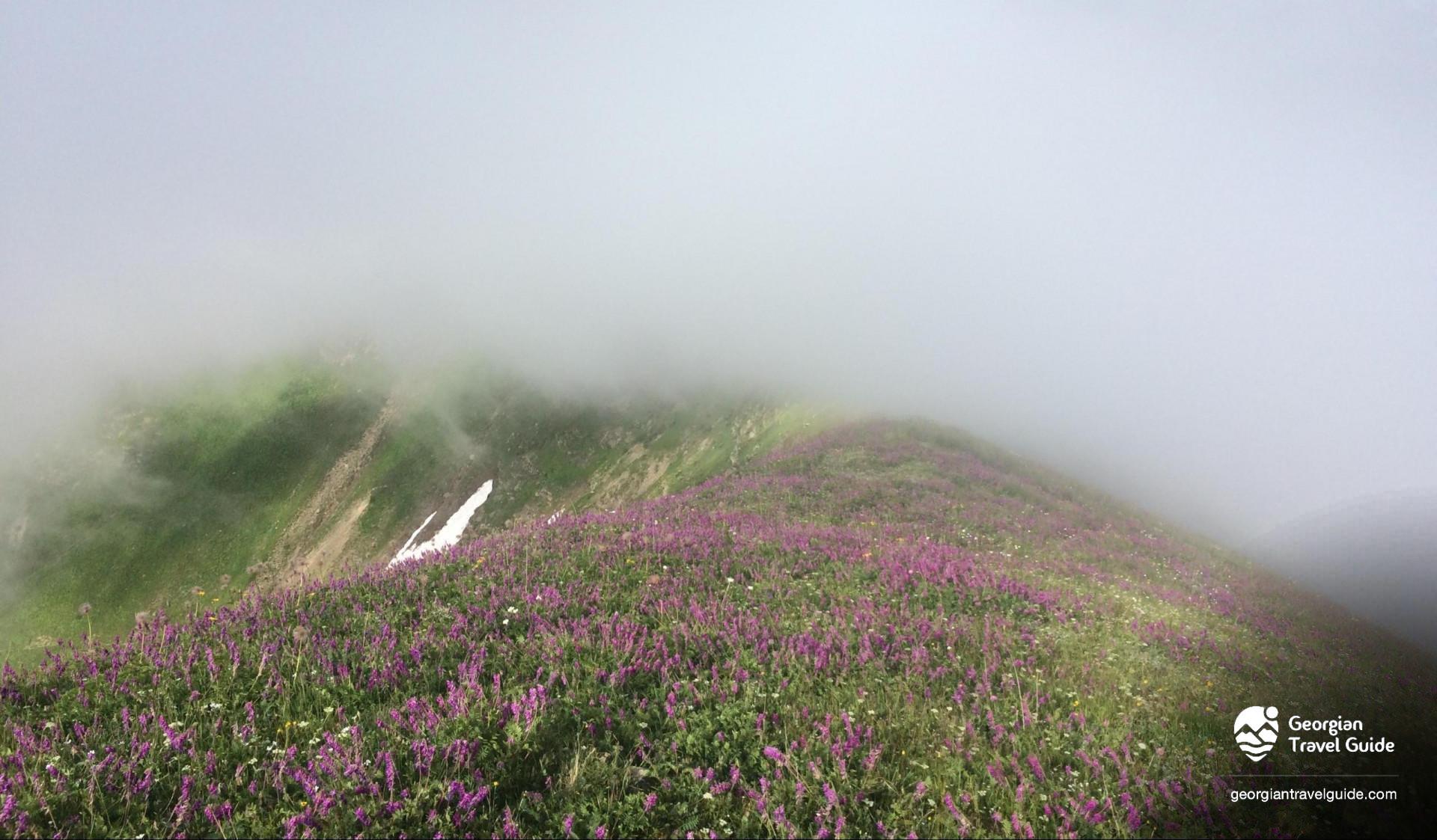
That night we slept peacefully, thinking that the next day would be much easier because we knew the way and we wouldn't have to wait for luck anymore. However, we were wrong, it rained heavily that night, and the next morning we waited in vain for the rain to stop. We had breakfast in the tent, put on our raincoats, and started walking at 10:45. It was raining... it was raining non-stop... You probably know that going down a rock is much more difficult than going up, especially when you have a backpack heavy with rain on your back and you are walking down a wet rock. The chance of slipping was very high, but experience paid off and we passed this most difficult section safely, descended into the river valley through wet grass and crossed rivers. It turned out that the sun is much less of a problem than rain when you are walking in grass taller than you. Wet grass makes you wet from head to toe and weighs you down, and the cold adds to that. In such conditions, we crossed the first pass and climbed the ridge separating Svaneti and Samegrelo. On the way, we overcame numerous obstacles, vertical rocks covered with wet snow, dampness, cold, wind, and terrible fog. Imagine, at 2800 meters above sea level, we were walking completely wet in the fog and wind. We were stepping on the snow that had turned into ice, where our feet were very slippery, and I don’t know how, but we were holding on. Below were abysses covered in fog, and we couldn’t even see where the ice steps were leading us. The fog once again convinced us that going into the mountains without a GPS device is very dangerous. It is very difficult to find our way in heavy fog, we had no idea where we were, even though we had passed those exact places just 12 hours earlier.
In this terrible situation, the only hope that we would find better weather on the other side of the pass was ours. And so it happened, on the other side of the pass the wind died down and we warmed up a little, although the descent was very difficult, we walked on wet grass, almost vertical rocks, and in order not to slip, we had to follow the bed of a small river. Sometimes we tripped on stones, fell, and slid, and so we descended into the Khobistskali gorge. Here we ate, gathered strength, and the suffering ended. The sun shone and made us feel that the scorching sun was better than the cold. From here we followed the already familiar paths to the camp, feeling like we were at home. We looked at Lake Tsakatskari and set off towards the camp. It was almost 6 pm when we descended from the fifth lake ( Tsakatskaris Toba ), crossed the Tsashkibuli Pass in broad daylight, and descended into fog and pitch darkness. We walked the last 2 kilometers in complete darkness. We walked through the fog at night without flashlights, only occasionally glancing at the GPS, which announced the approach of the finish line. At exactly 10:12 pm, our journey ended, ending in a camp lit by a bonfire and filled with the chatter of students.
In total, we climbed 4,755 meters in altitude, walked for 22 hours and 55 minutes, covered 42 kilometers, and averaged 1.8 km/h. And all of this in 37 hours.
We returned completely drained of energy and emotions, but it was worth it. We saw one of the most beautiful places on Earth and were once again convinced that we are much stronger than we think.
Thank God, Nick, I'm not afraid to go anywhere with this person because I believe he can do anything.
If you want to visit Lake Toba, check out this route:
https://georgiantravelguide.com/ka/khaishi-lakumurash-toba

 GEO
GEO  ENG
ENG  RUS
RUS 








 LOGIN WITH GOOGLE
Please login to add a comment
Write a comment